
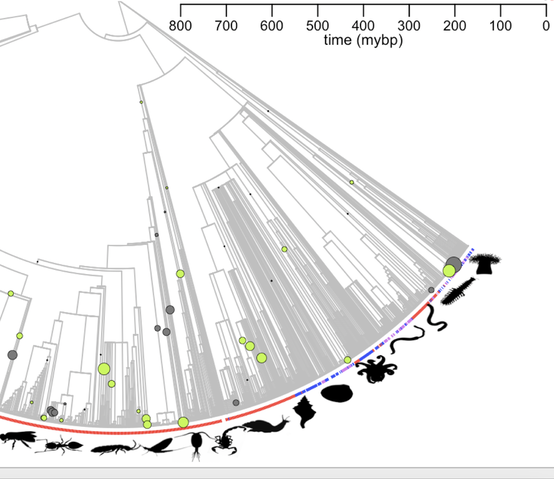
 Adaptive shifts detected in sperm length are presented as green (positive shift in sperm length) or grey (negative shift in sperm length) circles. The size of the circle representing the magnitude of the shift. External (blue) and internal (red) fertilizers are depicted at terminal branches of the phylogeny. Publication is forthcoming.
In promiscuous species, postcopulatory sexual selection is potentially one of the strongest forces of selection acting on males. Sperm are critical for male reproduction, and represent one of the few targets of sexual selection with homology across all animals, and can therefore act as a broadly informative model for understanding how postcopulatory selection creates variation in traits within and among species. The complexities of trait evolution require a synthetic approach, including quantification of patterns across species and processes within species. Using sperm morphology as a model, I compare patterns of evolution and examine processes that influence evolution (i.e. selection) and generating intraspecific phenotypic variance (i.e. condition-dependence).
______________________________________
Evolution of Sperm Morphology
For more than a century, evolutionary biologists have struggled to identify a unifying principle to explain the tremendous diversity in sperm morphology across the animal kingdom. One of the main forces that can affect a sperm’s ability to reach the egg is the environment that it moves through. We found that sperm is shorter in species whose sperm are diluted in external aquatic environments (e.g. external fertilizers and spermcasters), which sperm are longer in species with internal fertilization. Sperm length also evolves faster with a greater number of adaptive shifts in species where females interact with sperm (e.g. spermcasters and internal fertilizers). These results suggest that fertilization mode is a key driver in sperm evolution across animals, reshaping the selective landscape acting on sperm.
Across animals sperm length is variable, but even more variable perhaps is the shape of the cell. In many groups, sperm is made up of homologous structures, the head (which contains nuclear material), the midpiece (which contains mitochondria), and the flagellum (which propels the cell). These functional differences in sperm components likely result in variable evolution across the vertebrate tree. I have found that across the vertebrate tree of life, the midpiece evolves faster than both the head and the flagellum. This pattern is even more pronounced in groups with prolonged sperm storage (e.g. reptiles, salamanders, and birds), suggesting that the midpiece may be important for sperm longevity.
Check out our website SpermTree.org for more info on this project and to access our dataset!
______________________________________
Evolution of Sperm Morphology
For more than a century, evolutionary biologists have struggled to identify a unifying principle to explain the tremendous diversity in sperm morphology across the animal kingdom. One of the main forces that can affect a sperm’s ability to reach the egg is the environment that it moves through. We found that sperm is shorter in species whose sperm are diluted in external aquatic environments (e.g. external fertilizers and spermcasters), which sperm are longer in species with internal fertilization. Sperm length also evolves faster with a greater number of adaptive shifts in species where females interact with sperm (e.g. spermcasters and internal fertilizers). These results suggest that fertilization mode is a key driver in sperm evolution across animals, reshaping the selective landscape acting on sperm.
Across animals sperm length is variable, but even more variable perhaps is the shape of the cell. In many groups, sperm is made up of homologous structures, the head (which contains nuclear material), the midpiece (which contains mitochondria), and the flagellum (which propels the cell). These functional differences in sperm components likely result in variable evolution across the vertebrate tree. I have found that across the vertebrate tree of life, the midpiece evolves faster than both the head and the flagellum. This pattern is even more pronounced in groups with prolonged sperm storage (e.g. reptiles, salamanders, and birds), suggesting that the midpiece may be important for sperm longevity.
Check out our website SpermTree.org for more info on this project and to access our dataset!
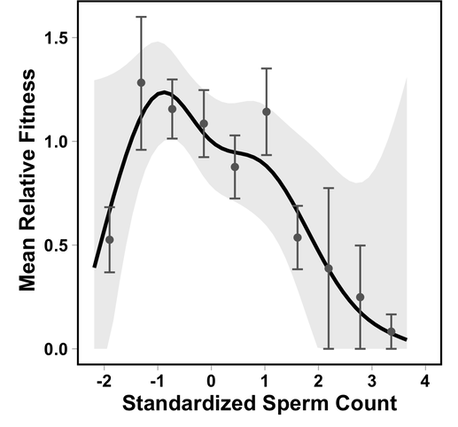 Univariate fitness surface for sperm count, which was characterized by both negative linear selection and negative quadratic selection. This figure summarizes males into 10 bins of approximately equal size, with mean ± SE for each group to better visualize the fitness surface.
______________________________________
Selection on Sperm Traits in the Wild
In a laboratory setting, selection on sperm traits can be very complex. But when individuals are able to mate freely in the wild, do we see similar complexity? With the Cox lab, I measured selection on sperm morphology, velocity, and count of a population of 171 male Anolis sagrei on an island in the Matanzas River in Florida. This population is part of a long-term mark-recapture study and is sampled several times annually. In 2015, we sampled the population four times and collected ~1000 adults and ~2000 hatchlings. To measure fitness, we designed a panel of primers using the GT-seq method. We measured both univariate and multivariate selection on our sperm traits and found that sperm count experienced negative directional and quadratic selection, but no other sperm trait experienced selection. This may reflect pressure on males to produce many small ejaculates, as mating occurs frequently and over an extended reproductive season in this species.
Selection on Sperm Traits in the Wild
In a laboratory setting, selection on sperm traits can be very complex. But when individuals are able to mate freely in the wild, do we see similar complexity? With the Cox lab, I measured selection on sperm morphology, velocity, and count of a population of 171 male Anolis sagrei on an island in the Matanzas River in Florida. This population is part of a long-term mark-recapture study and is sampled several times annually. In 2015, we sampled the population four times and collected ~1000 adults and ~2000 hatchlings. To measure fitness, we designed a panel of primers using the GT-seq method. We measured both univariate and multivariate selection on our sperm traits and found that sperm count experienced negative directional and quadratic selection, but no other sperm trait experienced selection. This may reflect pressure on males to produce many small ejaculates, as mating occurs frequently and over an extended reproductive season in this species.
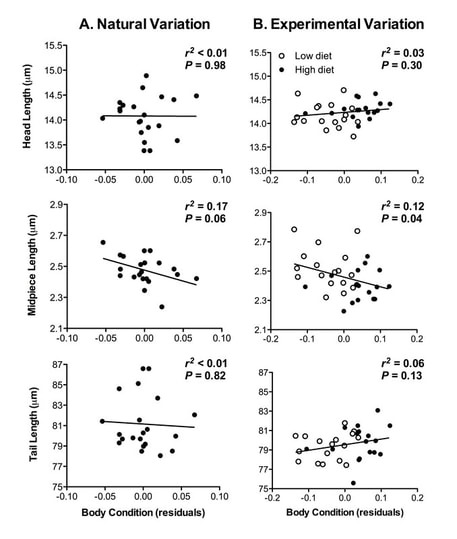 Correlation between body condition and sperm morphology in wild and experimentally manipulated male brown anoles.
______________________________________
Plasticity of Sperm Morphology
The evolution of a sexually selected trait can be complex and difficult to understand without examining the patterns of, and processes that generate, phenotypic variation at multiple levels of organization. I have examined factors that influence variation in sperm morphology within species and between populations. Using an experimental diet manipulation I found that males with low body condition had decreased total sperm production, decreased sperm head length and increased sperm midpiece length. I found the same pattern in wild populations, where males in lower body condition had larger sperm midpieces. Additionally, sperm morphology was more variable in low-condition suggesting that energy limitation detrimentally impacted the quantity, quality, and morphology of sperm. I also found that these changes in sperm morphology are partially responsible for condition-dependent reproduction in A. sagrei.
Sperm morphology is highly variable both within and among species of a wide range of taxa, however, the described variation is often only attributed to a single population. To test for differences between populations, I collected sperm samples from three species in an introduced population in Miami, FL, and from at least one native population in the Caribbean. These introduced populations of anoles have existed in Miami for less than 80 years, which allowed us to observe changes over a relatively short time. I found that multiple aspects of sperm morphology differed consistently among populations. Species from the introduced population had smaller sperm heads, larger sperm midpieces and smaller sperm tails than species from the native populations (though these differences were not always significant, the pattern was consistent among all three species). These data suggest that sperm morphology is highly plastic and/or capable of rapid evolution, potentially due to founder effects, genetic admixture within the introduced populations, genetic drift, or differences in selection.
Plasticity of Sperm Morphology
The evolution of a sexually selected trait can be complex and difficult to understand without examining the patterns of, and processes that generate, phenotypic variation at multiple levels of organization. I have examined factors that influence variation in sperm morphology within species and between populations. Using an experimental diet manipulation I found that males with low body condition had decreased total sperm production, decreased sperm head length and increased sperm midpiece length. I found the same pattern in wild populations, where males in lower body condition had larger sperm midpieces. Additionally, sperm morphology was more variable in low-condition suggesting that energy limitation detrimentally impacted the quantity, quality, and morphology of sperm. I also found that these changes in sperm morphology are partially responsible for condition-dependent reproduction in A. sagrei.
Sperm morphology is highly variable both within and among species of a wide range of taxa, however, the described variation is often only attributed to a single population. To test for differences between populations, I collected sperm samples from three species in an introduced population in Miami, FL, and from at least one native population in the Caribbean. These introduced populations of anoles have existed in Miami for less than 80 years, which allowed us to observe changes over a relatively short time. I found that multiple aspects of sperm morphology differed consistently among populations. Species from the introduced population had smaller sperm heads, larger sperm midpieces and smaller sperm tails than species from the native populations (though these differences were not always significant, the pattern was consistent among all three species). These data suggest that sperm morphology is highly plastic and/or capable of rapid evolution, potentially due to founder effects, genetic admixture within the introduced populations, genetic drift, or differences in selection.
